


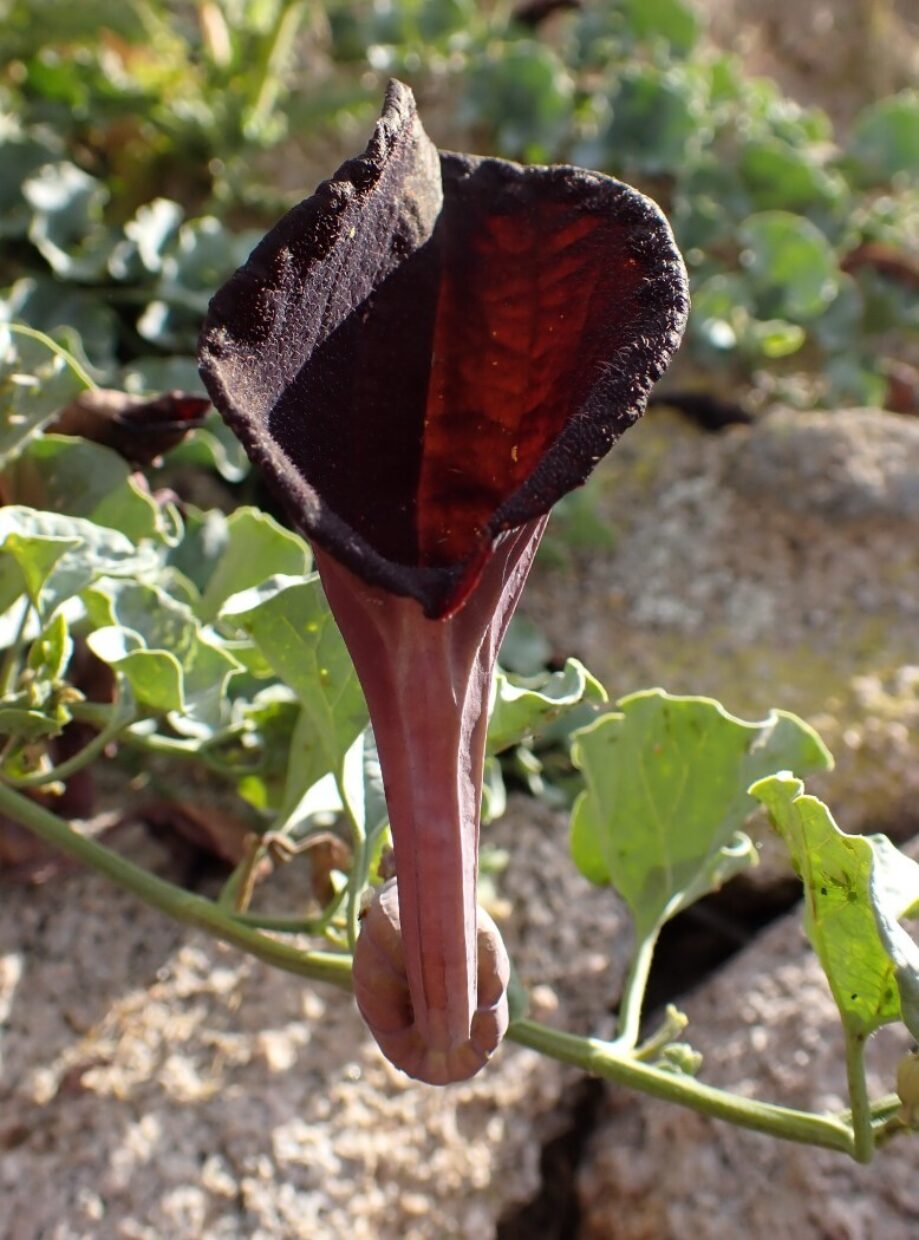
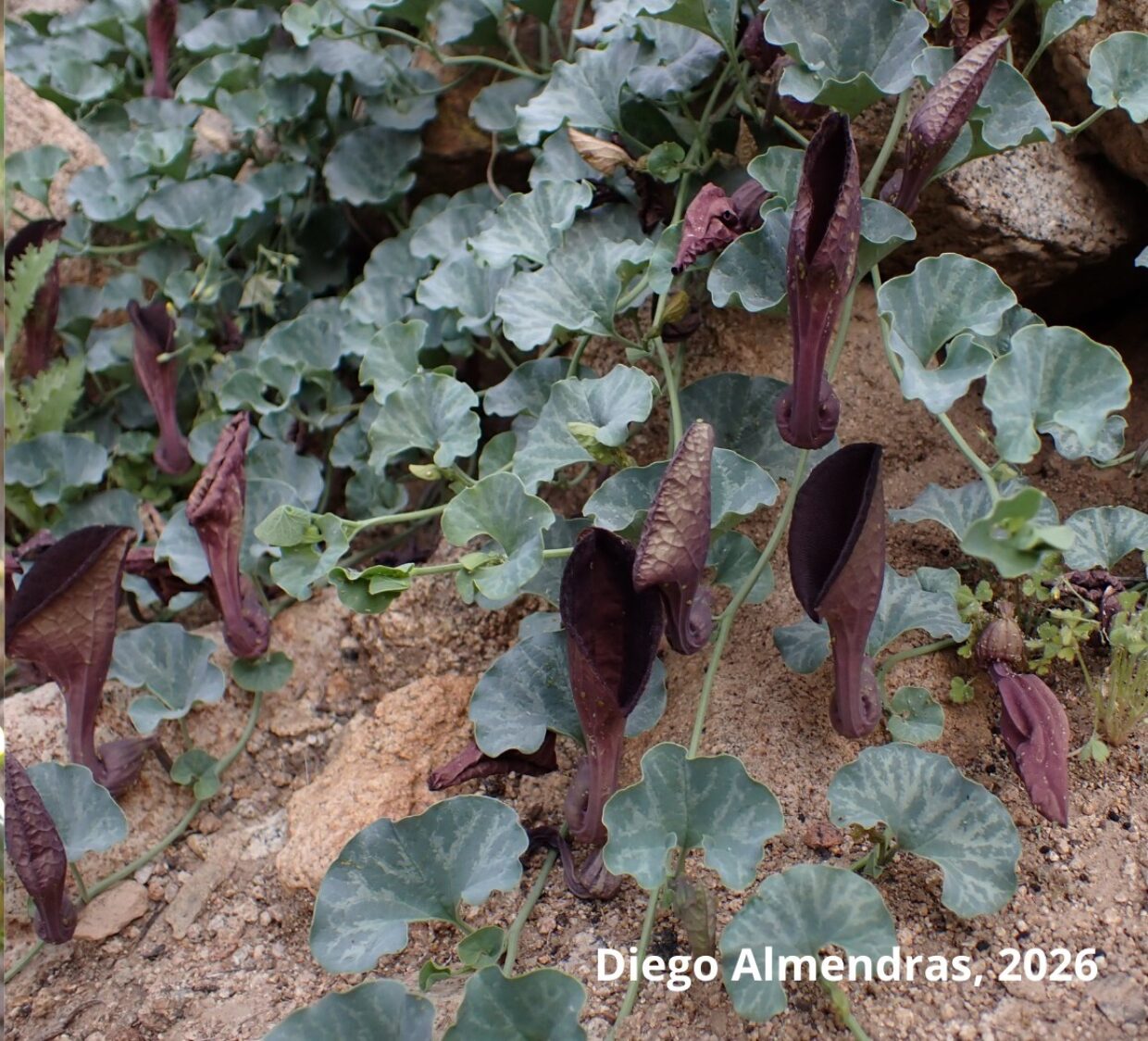
Cita del ejemplar Tipo
[Chile:] Coquimbo, Choapa, Salamanca, by the D-845, in a gorge between San Agustín and Zapallar, 31°43'18.1"S, 70°48'55.7"W, 1,065 m, 27 Oct 2022 (fl., fr.), D. Almendras s.n. (holotype: SGO, barcode 171805 [!]; isotypes: JBN, barcode 4905 [!]; VALPL, barcode 3003 [!]; UV [!]).
Referencias
-
Frank et al (2026)
Frank, D , Almendras, F D , Novoa, P , Cisternas, M y Lecocq, G 2026. Revision of the genus Aristolochia in Chile, with three new species, A. distorta, A. juntucha, and A. marinae. Brittonia 78(1):
Regiones
Distribución y habitat
Aristolochia marinae is only known from the high Chalinga River basin, where it occurs at 1,000–1,200 m elevation It is found in Mediterranean Andean Cool Semi-desert Scrub and Grassland in vegetation dominated by Leucostele chiloensis, Colliguaja odorifera, Spinoliva ilicifolia, Neltuma chilensis, Vachellia caven and Puya alpestris.
Categoría de conservación
- EN B2ab (ii,iii,iv)] (Frank et al (2026))
Hábito
Flowers between October and December. Fruits have been observed during the same period (Frank etal. 2026).
Características claves para su identificación
A. marinae is morphologically closest to A. vaginans and A. pearcei but differes by the relative lengths of the petiole and the peduncle plus ovary. Petioles are equal to or longer than the peduncle plus ovary in A. marinae vs. equal to or shorter than in A. vaginans and A. pearcei; the internal limb surface with short, reduced trichomes (vs. dense hispid trichomes in A. vaginans and A. pearcei); the limb’s opening widely gaping and inflated (vs. circular to ellipsoid in A. vaginans and A. pearcei); the tube broadly infundibuliform (vs. cylindrical in A. vaginans and A. pearcei), and the inclination angle of the limb 80–115° (vs. 140–190° in A. vaginans) [Frank etal, 2026]